
On 25 October 2026, Revolut closed my account. There was no drama on the day itself. Revolut had made the decision two months earlier, after a source-of-funds review that began at the end of July and left me without access to my own money for about two weeks.
Until then, Revolut was the centre of my financial life in Italy. I paid €9.99 a month for Premium, kept my savings there, held some Bitcoin and BNB in the app and made almost every payment through it.
Here’s the part I find hardest to admit. I study quantitative finance, I already hold a master’s in banking and finance, and I’m now doing a second master’s in financial engineering. If a compliance analyst had shown me my own transaction history without my name on it, I’d have flagged it too. I wasn’t doing anything dishonest; every euro I moved for other people went to application fees, document fees and insurance. Banks, however, don’t judge intentions. They judge patterns, and mine looked bad.
What follows is the full story: how my account turned into something Revolut was no longer willing to hold, what I’d do differently, and what to do if your own account is under review. When I explain Revolut’s reasoning, I’m reading it from Revolut’s published terms and help pages. They didn’t walk me through their decision line by line.
Why I Opened a Revolut Account in Italy
Newly arrived from Cameroon, I couldn’t simply walk into an Italian bank and open an account. In my experience, the traditional banks wanted documents I didn’t have yet, and things only get easier once your residence permit is out and your residence paperwork is under way. Until that point, most international students live on online banks and fintech apps.
Revolut was the easy choice. I created my account at the end of January 2026 and finished verification in the first days of February. Within minutes I had a European IBAN, a card and an app that made sending money almost too easy. To be fair to Revolut, it’s fast, well designed and genuinely useful. If you’re still choosing where to bank, I’ve covered the main options for newcomers in the best student bank accounts in Europe.
How My Account Became a Payment Hub for Other Students
Where my own money came from
My own income was modest and easy to explain. Family support came from Cameroon by standing order. The first transfer, on about 1 April, was just over €2,000 because several months had built up; after that, roughly €500 arrived each month. Relatives in Germany and elsewhere in Europe sent gifts from time to time, and I earned small amounts from remote online work.
Then there was other people’s money.
Why students needed me to pay their fees
Alongside my studies, I help African students, most of them Cameroonian, apply to universities and scholarships in Italy and beyond. Applying is one problem. Paying is often a bigger one. In my experience, PagoPA, Italy’s public payment platform, and many university portals regularly decline cards issued in Cameroon. Yet students still have to pay application fees, CIMEA statements of comparability and visa health insurance (many of mine chose the Welcome Association Italy policy, which cost them around €140).
How the mobile money chain worked
Few of my students could pay these fees directly, and I didn’t have spare savings to front the money. So we used a system that’s routine in the Cameroonian community:
- The student paid in CFA francs by MTN Mobile Money or Orange Money to a money transfer agent in Cameroon.
- The agent’s partner in Europe sent the euro equivalent, from their own European account, to my Revolut account.
- I paid the university, CIMEA or the insurer.
These agents work openly, and thousands of people use them. I don’t know exactly how they’re regulated, though, and one detail turned out to matter enormously: the euros never came from the student. They came from whatever account the agent’s partner chose to use that day.
How much money moved through my account
Application and visa season multiplied everything. Between late April and July, students were paying application fees, comparability statements and insurance at the same time. From 5 February to 15 August 2026, about €38,000 passed into and out of my account.
| Money in my account | How it arrived | How often |
|---|---|---|
| My family support | Standing order from a bank in Cameroon | Monthly, about €500 after the first catch-up payment |
| Family gifts | Transfers from relatives in Germany and elsewhere in Europe | Occasional |
| Remote work | Payments from online platforms | Occasional, small amounts |
| Students’ fees | Euro transfers from agents’ accounts, after Mobile Money payments in Cameroon | Frequent, peaking April–July |
The numbers tell the story on their own. €38,000 of combined activity over about six months works out to an average of roughly €6,000 a month on an account whose explainable income was about €500 a month. Much of the rest came from people I couldn’t properly identify.
The Timeline: From Review to Closure
| When | What happened? |
|---|---|
| End of January 2026 | Created my Revolut account |
| Early February | Completed verification and started using it |
| April | Monthly family support began; upgraded to Premium at €9.99 a month. |
| Late April – July | Student payments peaked during application and visa season. |
| Last days of July | Revolut requested proof of my source of funds, with a 15 August deadline. |
| Mid-August | Account restricted for about two weeks: no withdrawals, no payments |
| 24 August | Revolut emailed me that my account would close on 25 October 2026 |
| Before 25 October | Withdrew about €2,700 to an external bank account in my name |
| 25 October 2026 | Account closed |
The source-of-funds request
The request appeared in the app at the end of July. Revolut wanted to know where my money came from, and I had until 15 August to show it.
I didn’t ignore it. I explained my income from Cameroon, the family gifts and my online work. For the student payments, I tried to prove every link in the chain: screenshots of the students’ Mobile Money payments, screenshots of my Mobile Money transfers to the agents, and the matching euro transfers into my Revolut account. My logic was simple. If I could connect every step, the activity would make sense.
It was a lot of evidence. As I’d later understand, it was the wrong kind.
Two weeks with no access to my money
Around the deadline, Revolut restricted the account while the review continued. For about two weeks I couldn’t withdraw cash, pay a bill or buy groceries from my main account. I had a summer job, so I wasn’t entirely without income, but the money I actually lived on sat locked inside the app.
I wrote to support repeatedly. At one point I told them, quite literally, that I was stranded in Italy without money for food. Paying for a premium made no difference to the pace of the review.
The closure notice
On 24 August, Revolut emailed me its decision. After “carefully reviewing” my account, it was “no longer able to offer” me its services. The account would close on 25 October 2026, and the agreement between us would end. The email pointed to Revolut’s right to close an account when law or regulation requires it.
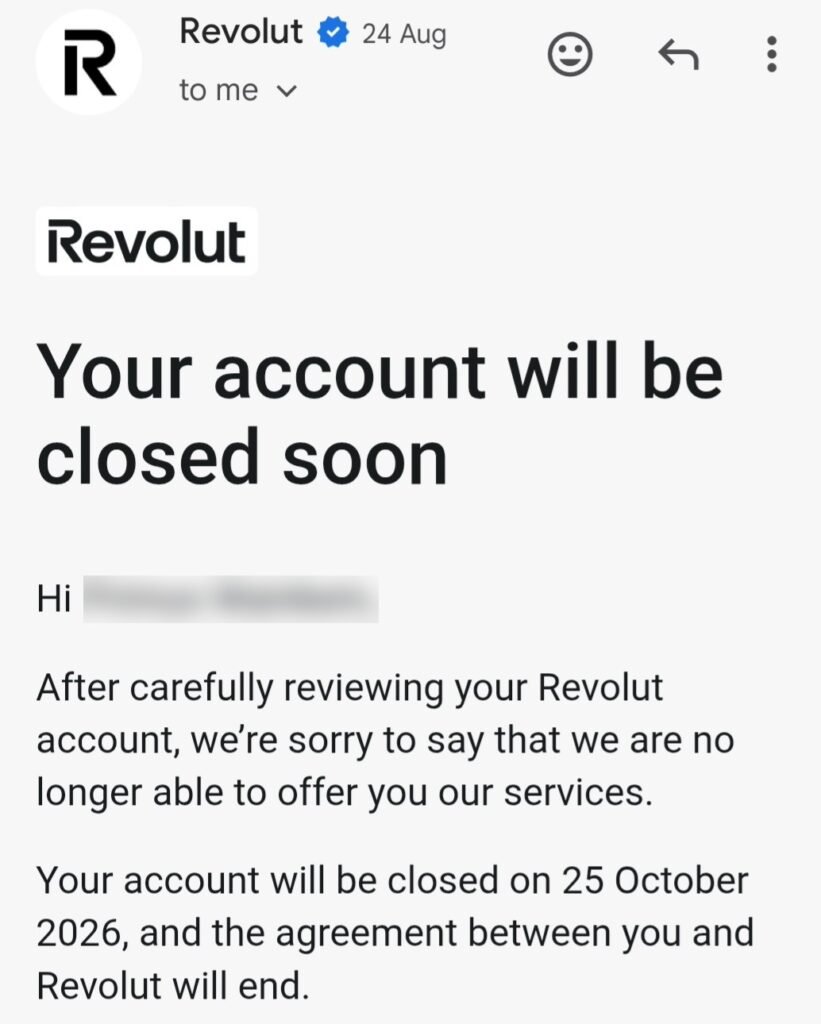
Revolut asked me to take my money out before the closing date and only let me withdraw to an external bank account, not to another Revolut user. I moved everything into my cash balance, sent out about €2,700, and on 25 October the account was gone.
That two-month gap wasn’t arbitrary. Revolut commits to contacting customers by app and email at least two months before acting on an account, and it sends the specific reason for a closure to the email address on file.
Why Revolut Closed My Account: My Reading as a Finance Student
Revolut publishes a non-exhaustive list of situations that can lead to closure: suspected fraud or harmful use of the app, missing or incorrect information, serious or repeated breaches of its terms, risk to its reputation, and legal or regulatory obligations.
Nobody accused me of fraud. Still, four features of my account would concern any transaction-monitoring system.
Turnover far beyond declared income
Banks have to understand where their customers’ money comes from, and their monitoring systems compare stated income with real account activity. A gap of more than ten to one between monthly activity and explainable income is exactly the kind of signal those systems exist to catch.
Money from people I couldn’t document
The euros came from agents’ partners, not from the students, after passing through Mobile Money in Cameroon. Revolut’s guidance says that when funds go through another account before reaching yours, it may ask for a statement from that intermediate account. I could never obtain statements from transfer agents, so my chain of evidence had a hole exactly where the bank needed proof.
A personal account behaving like a business
Revolut’s personal terms prohibit using a personal account for business purposes. Collecting money from many people and paying institutions on their behalf, week after week, resembles a payment service, even when you take nothing from the transfers themselves. Work you do for clients needs its own business setup.
Screenshots instead of documents
This was the most avoidable mistake. Revolut’s source-of-funds guidelines ask for PDFs or photos of physical documents, say they don’t accept screenshots, and require the name on documents to match the account holder. Nearly everything I submitted was a screenshot, and many showed other people’s names.
I’m not writing this to argue with Revolut’s decision. From the bank’s side, a student account turning over many times its owner’s income, fed by unrelated third parties and paying out to institutions, fits the profile of unlicensed money transmission. No bank is going to give that profile the benefit of the doubt.
What the Closure Cost Me
The immediate cost was two weeks without my own money while working and studying, and the anxiety of not knowing when, or whether, I’d get it back.
The lasting cost is that I can’t return. Revolut’s personal terms state that you can’t open a new personal account if Revolut has previously closed one, so I’m out, possibly for good.
I also lost the convenience, and I don’t pretend otherwise. Revolut remains an excellent app, and most of what I wrote in Wise vs Revolut for international students still stands. The app wasn’t the problem. My way of using it was.
What I Use Now
The restriction taught me something I’d often told other people and never applied myself: a single account is a single point of failure. I now spread my money across Wise, N26 and a third backup account, so no single app controls everything I have.
The rule is simple. No one app holds all my cash, savings and investments together. If one account freezes tomorrow, I can still pay rent and buy food.
What I’d Do Differently if I Were Helping Students Pay Again
Keep other people’s money out of your personal account
Where possible, the person who owes a fee should pay it directly, even if finding a working payment method takes extra effort. If you must pay on someone’s behalf, use a separate account for that purpose, never the account your rent depends on.
Record every payment from day one
For each payment you make for someone, keep three things: who sent you the money, what you paid, and the official receipt from the institution. A CIMEA payment confirmation or a university fee receipt in the student’s name is worth far more than any chat screenshot. Download PDF statements monthly rather than reconstructing months of history once a review has started.
Avoid money chains you can’t prove
Informal agents are fast and convenient, but they can’t give you statements. “It came from an agent’s partner” won’t satisfy a compliance team. Regulated transfer services issue named receipts, which makes them far easier to defend. I compare costs and options in how international students can avoid hidden bank charges.
Don’t keep everything in one fintech
My savings, my crypto and my everyday cash all sat in one app, so one restriction froze all of them at once. Keep a backup account and a small emergency buffer somewhere else.
Explain unusual activity before you’re asked
If your account regularly handles money for others, the bank will notice sooner or later. A clear explanation with documents, offered early, convinces far more than one you put together under a deadline.
If Your Revolut Account Is Under Review Right Now
- Read the request closely. Revolut lists the documents it needs on the submission screen, so answer exactly that.
- Upload real documents. Use PDFs or clear photos of physical documents, such as payslips, bank statements, scholarship letters or tax documents, with names matching your account where possible.
- Describe any chain in writing. If money passed through another person or account, say so plainly and attach proof for each step you can.
- Meet the deadline. Failing to provide requested information is itself one of Revolut’s listed reasons for closure.
- Redirect essential income now. Move your scholarship, salary or family transfers to another account while the review is open.
- If Revolut announces a closure, check your registered email for the reason and use the notice period to move your money to an account in your own name.
Frequently Asked Questions
Why did Revolut close my account without a clear explanation in the app?
Revolut says it sends the specific reason for a closure to the email address registered on the account, so check your inbox and spam folder. Its general reasons include missing information, breaches of its terms, suspected fraud, reputational risk and legal or regulatory obligations.
Can I open a new Revolut account after Revolut closed my old one?
Revolut’s personal terms say no: you can’t open a new personal account if Revolut previously closed one. If you closed the account yourself, the situation is different, and Revolut’s help centre suggests simply opening a new account.
How much notice does Revolut give before closing an account?
Revolut says it contacts customers by app and email at least two months before acting on an account. Mine followed that pattern, with notice on 24 August and closure on 25 October. Its terms also allow faster action in exceptional circumstances.
How long does a Revolut source-of-funds review take?
There’s no single answer; it depends on your case and how quickly you send acceptable documents. My request arrived at the end of July, and Revolut restricted the account for about two weeks around mid-August before deciding.
Is it safe to receive money in my account for friends or family?
An occasional transfer from a relative is normal. Regularly collecting money from many people and paying it out for them is different, because it can look like a business or payment service, which personal accounts aren’t meant for. If you do it, keep receipts for everything and use a separate account.
What documents does Revolut accept as proof of source of funds?
Depending on where your money comes from, Revolut mentions tax documents, payslips, bank statements and similar records. They can be in any language, but names should match your account, and Revolut doesn’t accept screenshots.
Where This Leaves Me
I lost an account I liked, two weeks of peace of mind and any future with Revolut. In exchange, I learned more about anti-money-laundering controls than any lecture had taught me. If you’re an international student handling payments for others, take the lesson from my story rather than from your bank.
This article describes my personal experience and is for educational purposes only; it isn’t legal or financial advice. Revolut’s terms differ by country and change over time, so check the current terms that apply to your account.